
Spaced Repetition Explained: How FSRS Decides When to Review
Spaced repetition reviews material just before you would forget it. This guide covers the forgetting curve, the FSRS memory model and how a retention target sets review timing.


Spaced repetition means reviewing an item shortly before you would be likely to forget it, then waiting longer before the next review. Each review that succeeds lets the memory last longer. FSRS, which stands for Free Spaced Repetition Scheduler, is an open-source algorithm that estimates how well you remember each item and chooses the next review day for a retention target you set. This article explains the idea behind it, what the model assumes, and where its limits are.
Key takeaways
- Reviewing just before you would forget costs less effort than cramming after you have forgotten, and it keeps more of the material.
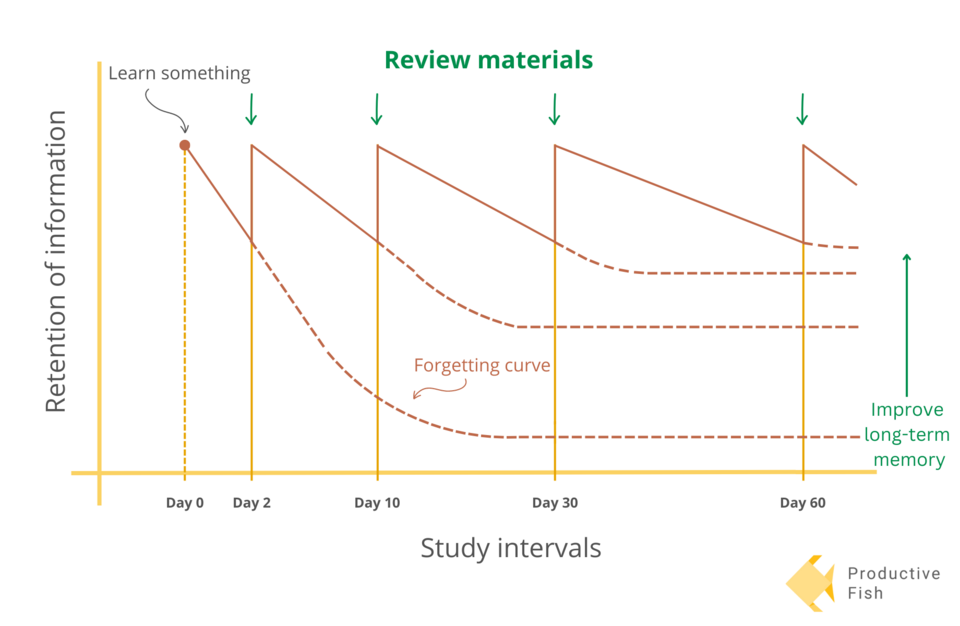
- Forgetting is fastest soon after learning, so the first reviews come soonest and the later ones can be spaced further apart.
- FSRS describes each item with three quantities: difficulty, stability and retrievability.
- The retention target is a trade-off between the number of reviews and the chance of recall. It is not a guarantee.
- The schedule learns from your answers, so honest ratings matter more than any setting.
In this article
Why timing matters
A card you see the day after learning it is easy to recall, and reviewing it again tomorrow can feel wasteful. A card you see after you have forgotten it takes more effort, and you may have to relearn it. The useful moment falls between those two points: close enough that recall succeeds, far enough that recall takes effort. Spaced repetition software tries to find that moment for every item. Newer and harder items come back sooner, and older, easier items come back less often.
What the forgetting curve shows
Hermann Ebbinghaus pioneered the experimental study of memory. In 1885 he published Über das Gedächtnis (later translated as Memory), in which he measured how much he could recall after set intervals. He used nonsense syllables, consonant-vowel-consonant combinations, so that existing word associations would not help him. The result is the forgetting curve. Retention falls steeply at first and then more slowly.


A common summary of the curve is that people tend to lose about half of newly learned material within days or weeks unless they review it. Treat that as a rule of thumb. The exact rate depends on the material, the learner and how well the item was learned in the first place. The forgetting curve article on Wikipedia gives the historical background and the caveats.
Why spacing works
Ebbinghaus also described the spacing effect: material studied across separate sessions is often retained better than the same total time spent in one block. Spaced repetition turns that observation into a schedule. Wikipedia describes it as an evidence-based technique, usually performed with flashcards, and commonly applied where a learner must acquire many items and keep them for a long time. Vocabulary learning is the classic example.
The figure below is an illustrative diagram of the same idea. Each review raises retention, and later reviews can be spaced further apart. The day numbers are illustrative and do not describe a particular person.

How FSRS models a memory
The FSRS project describes its model with three variables: difficulty, stability and retrievability. Stability is the storage strength of a memory: the higher it is, the more slowly the memory is forgotten. Retrievability is the current retrieval strength: the lower it is, the more likely a recall attempt is to fail. After each review, the algorithm updates these values from your rating.
The current FSRS documentation writes the forgetting curve as R(t,S) = (1 + factor × t/S) raised to a negative decay exponent, where the factor is chosen so that retrievability equals 90% when t equals S. The decay exponent is trainable, so it can be fitted to a learner's review history. In practical terms, stability is the number of days after which recall is expected to be about 90% likely, if the model fits that learner. The FSRS algorithm page has the full formulas.
The model is an estimate. It can be wrong for an item you have studied in an unusual way, or after a long break, and it depends on the answers you give. Revising an estimate as each new observation arrives is a habit the base-rates article discusses in a business setting. If giving recent observations more weight than older ones sounds familiar, the article on moving averages and exponential smoothing covers a related trade-off.
Choosing a retention target
The scheduler sets the next review so that retrievability is expected to reach the retention target you chose. The target is a setting, not a promise. Anki calls the same idea "Desired Retention" in its FSRS options. A higher target produces shorter gaps and more reviews, and a lower target produces longer gaps and more forgetting between reviews.
| Setting | Effect on the schedule | Trade-off |
|---|---|---|
| Lower target | Longer gaps between reviews | Fewer reviews, but more items are forgotten before they come back |
| Higher target | Shorter gaps between reviews | Better expected recall, but a larger review workload |
A reasonable starting point is the setting you can keep for the whole course. If the review load becomes unmanageable, lower the target and watch what happens to your recall over the next few weeks. Changing it every day makes the results hard to read.
How ManySpace uses reviews
ManySpace is Aporia Systems' study map for mathematics, physics and AI/ML. It shows the prerequisites for a topic and includes a review queue. Its About page states that the FSRS memory model schedules reviews from your answers and your chosen retention target, and that a target is not a guarantee of recall. The same page describes mastery as an estimate built from recorded study, practice and review evidence. It is not a qualification or an independent assessment.
The two parts do different jobs. The prerequisite map shows what a goal depends on, so you know what to learn before a topic. The review queue decides which material to recall now. Both depend on honest use: a review queue cannot repair a topic you have not studied, and a prerequisite map cannot show what you have forgotten. The products page lists ManySpace alongside KPI Master, the company's browser tool for spreadsheet exports. Aporia Systems is an independent studio, and the about page describes the people behind it.
If you find an error in an article or in a study tool, send the details through the contact page. More articles are listed on the blog index.
Spaced review without an app
You can apply the same logic on paper or in any flashcard tool:
- Write one question per card. A card that asks for three things is three cards in practice, because you can only rate it once.
- Put new cards in the first box of a Leitner system, a set of boxes reviewed on a schedule. Correct answers move a card to a box that is reviewed less often. A wrong answer sends it back to the first box.
- Review the boxes on a fixed schedule that you can keep up.
- Answer from memory before you look at the back. Recognising the answer is not the same as recalling it.
- Rate your answers honestly. A guess that you recognised afterwards is a wrong answer for scheduling purposes.
If you use Anki, its manual notes that Anki 23.10, AnkiMobile 23.10 and AnkiWeb all support FSRS. The deck options section of the manual explains the FSRS settings, including the desired retention value.
Common mistakes
- Cards that hold too much. A card with a whole paragraph is hard to rate honestly. Split it into smaller questions.
- Rating by feel. A scheduler learns from your answers. Inflated ratings push reviews later than your memory supports.
- Cramming a backlog. A large pile of overdue cards is usually easier to clear in steady sessions than in one exhausting block.
- Recognition instead of recall. If you read the answer and nod, the card has not tested recall. Cover the answer first.
- Treating review as the whole method. Flashcards keep items available. Problem solving and worked examples still need practice, because recalling a definition does not show that you can use it.
Frequently asked questions
What does FSRS stand for?
FSRS stands for Free Spaced Repetition Scheduler. The open-source project's README describes it as a Free Spaced Repetition Scheduling Algorithm, and the name refers to the algorithm rather than to any app.
What retention target should I choose?
There is no single right value. A lower target gives longer gaps and more forgetting between reviews. A higher target gives shorter gaps and more reviews. Pick a target you can sustain for the length of the course, and adjust it only after a few weeks of data. A target is not a guarantee of recall.
Is spaced repetition only for vocabulary?
No, but it suits material that can be split into items you must retain, such as vocabulary, definitions, formulas and facts. Subjects such as mathematics also need worked practice. Recalling a definition does not show that you can apply it to a problem.
Why did a card come back sooner after I missed it?
A missed recall suggests that the memory was weaker than the schedule assumed, so the model brings the card back sooner. This follows from the scheduling model. It is not a penalty, and the next interval depends on the card's history and your settings.
Do I need a dedicated app?
No. A paper Leitner system works, and so does any flashcard tool you already use. Some FSRS implementations can fit the model's parameters to your own review history, which can make the schedule more precise.